
Henry County Court Records After a Jail Arrest
After an arrest in Henry County, the booking happens at the jail, but the charges that matter are filed by the Henry County State's Attorney, currently Cathy Runty. That filing opens a case, and the Henry County Circuit Clerk maintains it as the official court record. The clerk files every case and keeps the authoritative record of matters before the county's courts, so the court record, not the arrest paperwork, is where the formal charges and outcomes appear. Booking charges listed at intake can be preliminary and may change once the prosecutor reviews the case.
It helps to keep the two sides straight. The arrest and booking side covers custody and is handled through the jail inmate records channels, and booking photos are covered on the jail mugshots page. The court record side covers the charges the prosecutor filed and how the case moves. This page deals with the court record that follows the arrest.
How to Find Henry County Court Records After an Arrest
The Henry County Circuit Clerk sends the public to Judici for participating-court case data and links the county case search from its records page. Judici is a third-party court-records platform, so official certified copies still come from the clerk, but the search is the fastest way to find a case after an arrest.
- Open the Circuit Clerk records page and follow the link to the Henry County Judici case search.
- Search by defendant name, using last name then first name, or by case number if you have it.
- Open the case to read the charge list and the filed charging documents.
- Check each charge's class and current status, plus hearing dates and any disposition.
If the online search is gated or you need a certified record, the clerk also takes criminal and civil record-search requests by email and by fax at 309-937-3990, and the office answers at 309-937-3572. A statewide criminal-history check is a separate process handled by the Illinois State Police, not the county clerk.
The county's Circuit Clerk Records Search page links the Judici case search and lists the clerk's request channels.
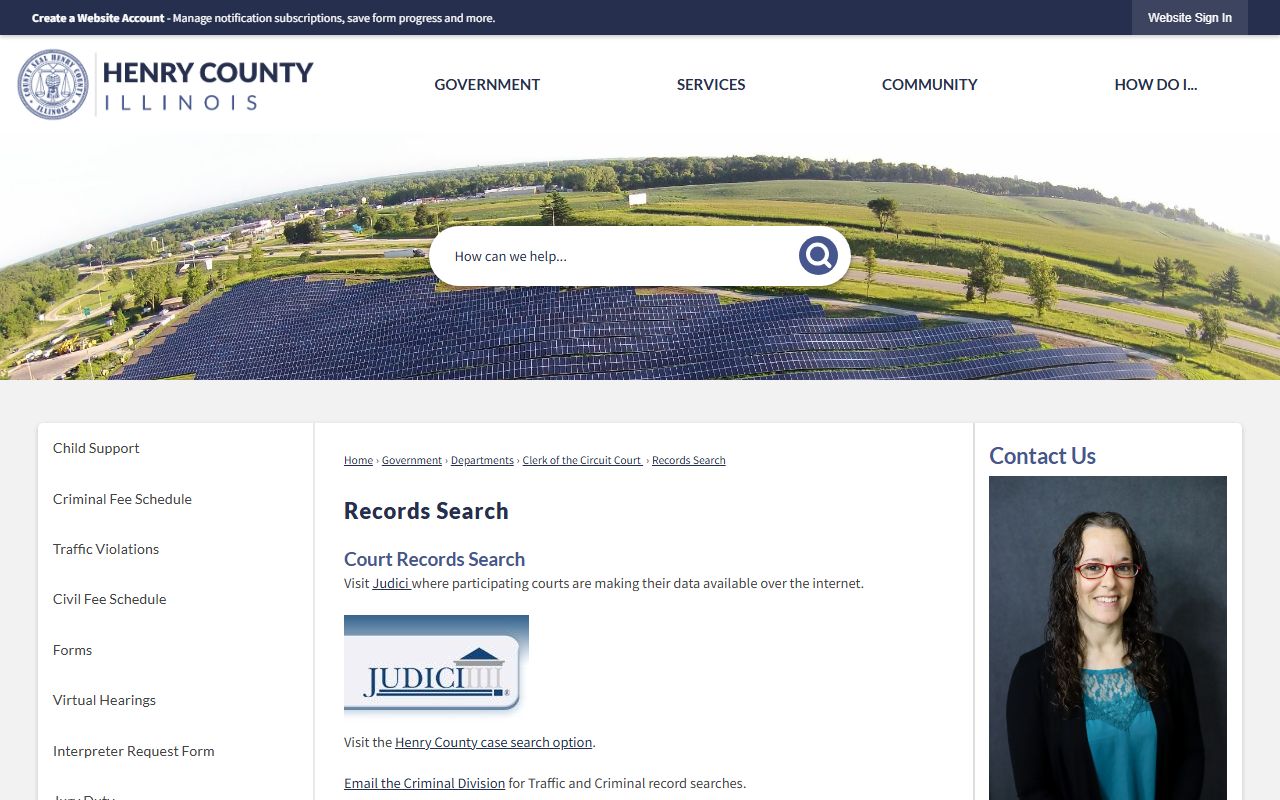
From that page the clerk points users to Judici for the case index and gives the email and fax routes for records that are not online.
| Field Label | Type | Required | Notes |
|---|---|---|---|
| Case Number | Text | Optional | Use when you already have the case number |
| Name / Party | Text | Optional | Last name, first name, middle initial |
| Court | Fixed | Yes | Henry County court parameter IL037015J |
| Search | Button | Yes | A captcha may appear before the form |
How Charges Get Filed After an Arrest
The court record begins when the prosecutor files a charging document. Booking happens first at the jail, then a first appearance under Illinois law informs the defendant of the charge, addresses counsel, and handles pre-trial release or detention. In Illinois, a case can proceed by complaint, by information, or by indictment, depending on the offense and the stage. Felony prosecutions by information generally require a preliminary hearing with probable cause or a waiver, while a grand jury returns an indictment.
| Complaint | Information | Indictment | |
|---|---|---|---|
| Filed By | Officer / Prosecutor | State's Attorney | Grand Jury |
| Common For | Misdemeanors | Many felonies | Serious felonies |
| Starts | The case | The case | The case |
Which document applies depends on the offense and how the case proceeds. A misdemeanor often moves on a complaint, while a felony typically requires either a grand jury indictment or an information backed by a preliminary hearing that finds probable cause. The charge that lands in the court file may not match the booking charge from the arrest, because the State's Attorney reviews the case and decides what to file. That review is why the court record, not the intake paperwork, is the document to trust.
Charge Status in Henry County Court Records
Charges shift as a case moves, so the status on a court record can differ from the charges booked at arrest. A prosecutor may amend, reduce, add, or drop charges, and a judge may dismiss them. The booking charge on an intake report is not the final word; the court record is. The common status terms below show up in a Henry County case file.
| Status | What It Means |
|---|---|
| Pending | The charge or case is still active and not yet resolved. |
| Amended / Reduced | The prosecutor changed the charge or lowered it to a lesser offense. |
| Dismissed | The charge ended without a conviction. |
| Nolle Prosequi | The State chose not to pursue the charge. |
Circuit Clerk Channels for Court Records
The Henry County Circuit Clerk is the office that keeps the official court record, attends court sessions, and collects fines, fees, and costs. When the online index is not enough, the clerk takes record-search requests through several channels. The Criminal Division handles traffic and criminal record searches by email, the Civil Division handles civil searches, and requests can also be faxed to 309-937-3990. The main clerk office sits at 307 West Center Street in Cambridge and answers at 309-937-3572.
Hours and court times are worth checking before a trip. The clerk's office runs Monday through Friday from 8 am to 4:30 pm, court generally begins at 9 am on weekdays, and there are short walk-in windows for civil and traffic matters. A separate Kewanee Division at 401 East Third Street, reachable at 309-852-2507, handles traffic citations, ordinance violations, and conservation tickets, and holds court on Fridays. For a hearing you plan to attend, confirm the judge, courtroom, or video link with the clerk first, since virtual hearings are assigned by case type.
Bond and Release After an Arrest
Illinois ended cash bail statewide on September 18, 2023 under the Pretrial Fairness Act, so release after a Henry County arrest no longer turns on a posted dollar amount. There is now a presumption of release on personal recognizance unless a court orders detention, and the State must petition and show, by clear and convincing proof, why detention or restrictive conditions are needed. The jail rules page still uses the old "bonded out" wording and tells people to call the jail, so expect the court order rather than a cash figure to control release.
| Release Path | How It Works |
|---|---|
| Personal recognizance | Release on a promise to appear and follow conditions, the Illinois default. |
| Conditional release | Release with conditions such as no-contact orders, monitoring, or testing. |
| Detention | Court-ordered pre-trial custody after a verified State petition. |
| Hold / detainer | A separate agency, warrant, or federal matter keeps the person in custody. |
Home detention is a documented local alternative. Henry County Court Services screens Electronic Monitoring Home Detention, which a judge can order before or after conviction, generally for 30 to 180 days, and GPS may apply in certain order-of-protection cases after a risk assessment.
Warrants That Lead to an Arrest
An outstanding warrant is a common route into the Henry County Jail. An arrest warrant authorizes a person's arrest, and a bench warrant often follows a missed court date. Research located no official online warrant search for the Henry County Sheriff's Office, so there is no public warrant lookup to rely on. To check whether a case carries a bench warrant or a failure-to-appear history, search the case on Judici or contact the Circuit Clerk at 309-937-3572. For enforcement questions, the Sheriff's Office answers at 309-937-3911, with the understanding that a confirmed active warrant can lead to custody. Do not trust unofficial warrant sites, which are often wrong.
Charges vs. Convictions
An arrest and a charge are an accusation, not a finding of guilt. A conviction comes only after a plea or a verdict. Both a charge and a conviction can appear in the public court record, but they mean very different things, and treating a charge as a conviction is a common and serious mistake.
| Charge | Conviction | |
|---|---|---|
| Stage | Accusation | Verdict or plea |
| Burden of Proof | Probable cause | Beyond a reasonable doubt |
| Public Record | Yes | Yes |
Sealed vs. Expunged Court Records
Illinois lets eligible people clear a record after a dismissal or a qualifying outcome through the petition-based process in the state's expungement and sealing law. Sealing limits public access while leaving the record in existence, and expungement goes further, treating the record as if the arrest or charge never happened. Eligibility depends on the offense and the disposition, and the process runs through the court, not a website takedown.
| Sealed | Expunged | |
|---|---|---|
| Visibility | Hidden from the public | Destroyed or treated as never existing |
| Law Enforcement | Limited access remains | Very limited access |
| Eligibility | Many sealable offenses under 20 ILCS 2630/5.2 | Narrower; dismissals and eligible arrests |
Background Check Considerations
A casual name lookup in a court index is not the same as a regulated background check. Formal employment, tenant, and credit screening must follow the federal Fair Credit Reporting Act and use a licensed consumer reporting agency. Court records seen here are public information, not a compliant report.
Important: This is a private reference site, not an FCRA-regulated consumer reporting agency, and nothing here may be used for hiring, housing, credit, or insurance decisions.
Restricted Court Records After an Arrest
Not every court record after an arrest is open. Juvenile cases are generally restricted, sealed and expunged matters drop out of public view, and Illinois FOIA allows records to be withheld when disclosure would interfere with an active investigation, endanger safety, or compromise correctional security. Some charges that are dismissed may later be sealed and disappear from the public index. When a case you expect to see is missing, a restriction or a sealing order is often the reason rather than an error.